

May 12, 2026
Is India competitive in exporting Green Ammonia to Europe?
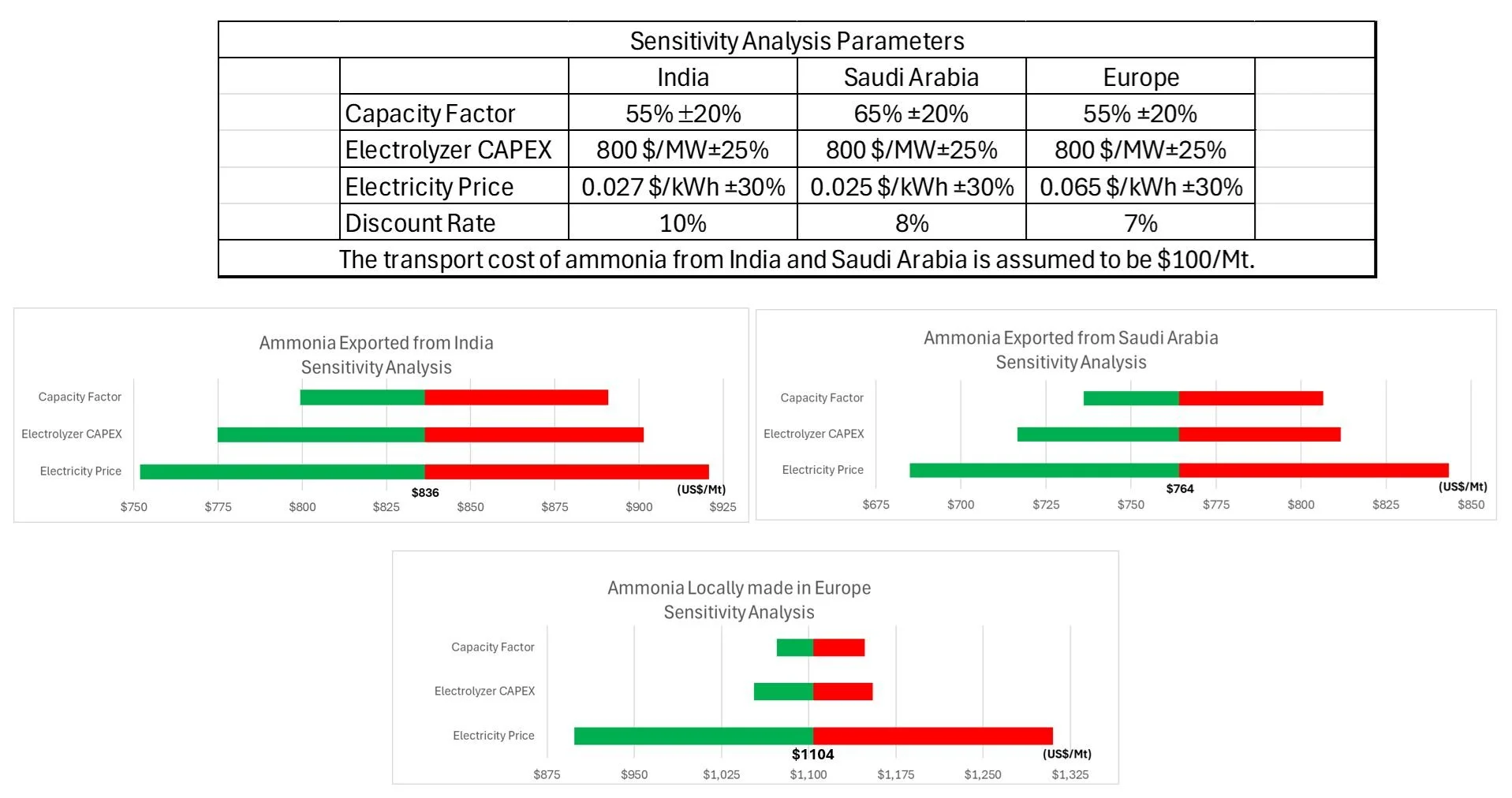
Is it actually profitable to export green ammonia from India to Europe? People say India's sunshine makes it cheap to produce. Let us verify if the business case holds up.
Let us first calculate the Levelised Cost of Hydrogen (LCOH) based on assumptions about electricity prices, electrolyzer efficiency, and capital costs, which influence the total cost to produce 1 kg of green hydrogen (including equipment and operating costs). We use LCOH to find the Levelised Cost of Ammonia (LCOA). We will add $100/mt to cover transport costs for ammonia from India and Saudi Arabia to Europe. We will call the final cost(LCOA + transport cost) the Cost of Green Ammonia. We ask how various factors, such as regional electricity prices, capacity utilization factor, and electrolyzer CAPEX, affect the cost of green ammonia for a 100 MW PEM electrolyzer plant connected to renewable electricity. We will consider three regions: India, Saudi Arabia, and Europe. Below, we show the sensitivity analysis for each region, along with the parameters used to compute it.
It is exciting to see that the Indian green ammonia cost of $836, which is about 24% lower than the European cost of $1104. However, green ammonia from Saudi Arabia costs $764, about 8% lower than the Indian green ammonia. Does it compete with locally produced grey ammonia? The average cost of grey ammonia is about $500, depending on TTF natural gas prices. However, Europe imposes a carbon tax (the EU Emissions Trading System (EU ETS)) of €75/mt of CO2. Assuming 1.7 mt of CO2 is produced per 1 mt of ammonia, a $140 carbon tax is added to the cost of grey ammonia, bringing the total to $640, which is about 23% lower than the imported green ammonia from India. For imported grey ammonia, the EU imposes the Carbon Border Adjustment Mechanism (CBAM), which brings parity in costs with locally produced grey ammonia. Thus, Indian Green ammonia is still 23% more expensive than imported grey ammonia. But Indian green ammonia can be sold at a premium. To command premium pricing for green ammonia in Europe, compliance with the EU's RED III directive and its strict RFNBO standards is mandatory.
Looking at the sensitivity chart for the Indian case, we see that when the electricity price is reduced by 30%, the cost drops to $752, which is still above the magic figure of $640 for grey ammonia with carbon tax. If we apply both the levers of Electricity price and Electrolyzer CAPEX, we arrive at $662, which competes with the cost of grey ammonia with carbon tax. When we use an Alkaline electrolyzer instead of a PEM electrolyzer, CAPEX reduces to $350/MW, bringing the cost down to $679.
Recognizing the influence of policy and technical factors is crucial, as addressing these can build confidence in the project's viability.
Author: Dushyant C. Kothari