

June 26, 2026
Make in India for a Greener World blog
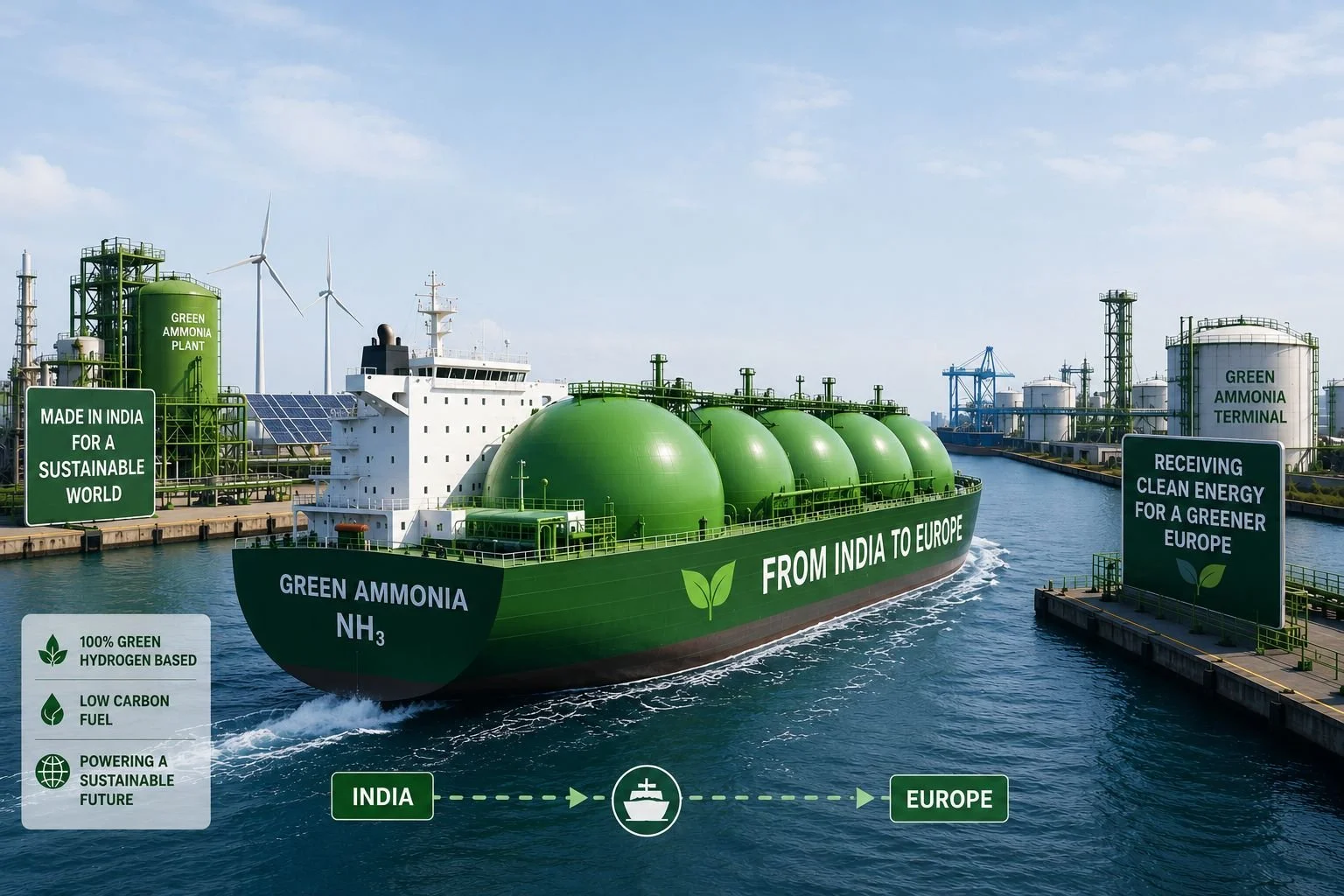
The question on my mind today is, how can I make the Green Ammonia project feasible in India? It's an exciting challenge, and I'm eager to explore ways to bring this idea to life. My common sense tells me that if I manufacture in India and export to Europe, then the project would become economically viable. Let us see if that is true. I see many barriers to my journey, and I wish to find ways to overcome them.
Let me explore whether the hydrogen policies of India and Europe could open the gates through the barriers I face. India's green hydrogen policy is favorable to green fuel manufacturers, with a focus on supply-side optimization. In contrast, the European policy is friendly to purchasers of green fuels, focusing on demand-side mandates. The EU has set a target to produce 10 million tons of green fuel and to import an additional 10 million tons by 2030. This is the best set-up I can think of for tapping the European green ammonia market.
However, we must get RFNBO certification. What is RFNBO? It stands for Renewable Fuels of Non-Biological Origin. That is, one can use only solar- or wind-based renewable energy sources. There are additional requirements: 1) One can not use electricity from old solar plants. One must build a new solar plant for the electrolyzer. 2) The solar plant should be in the same geographical location. It should be physically connected to the electrolyzers, and 3) Renewable electricity can not be 'banked' in the grid. Hydrogen must be produced when renewable electricity is produced.
Ah, but what benefit do we get from strictly complying with EU standards? Firstly, only if we comply with RFNBO standards will the fuel we produce be considered 'Green' fuel. If it is a 'Green' fuel, it can be sold in the EU at a premium price. We become eligible for fixed-premium "Auctions-as-a-Service" subsidies from the European Hydrogen Bank to bridge the price gap between renewable and fossil-based hydrogen.
However, the steepest barrier I face is the cost. The cost of gray ammonia in Europe is about $500 per ton. In contrast, green ammonia imported from India would cost about $840 per ton (when produced using a 100-MW PEM electrolyzer plant). Technology comes to my rescue. If I use an alkaline electrolyzer plant with a CAPEX cost of $350/kW, the cost of imported green ammonia reduces to $727 per ton.
Furthermore, if the renewable electricity price is reduced from 2.98/kWh to 2.25 /kWh, the cost drops to $647 per ton. In addition, the EU disincentivizes the use of gray ammonia by imposing a carbon tax. The carbon tax increases the cost of gray ammonia to $640 per ton. I have already become competitive with fossil-fuel-based ammonia. If I add the premium, I am in the business of exporting green ammonia to Europe. Let me contact my bank immediately for the project finance!
Author: Dushyant C. Kothari