
From Sample to Solution – Simple & Fast
Electrochemical Impedance Spectroscopy (EIS)
Researchers, do you face problems? like,
Energy devices deliver lower power output because high charge-transfer resistance impedes efficient electron flow.
Poor compatibility between the electrode and electrolyte leads to unstable performance and premature device failure.
Batteries and electrocatalysts suffer from slow ion diffusion, limiting efficiency and rate capability.
Internal resistance increases over time, causing overheating, energy loss, and reduced operational lifespan.
Protective coatings fail unexpectedly due to barrier breakdown, exposing materials to aggressive environments.
Corrosion remains undetected in its early stages, resulting in costly structural damage and increased maintenance costs.
Interfacial instability between materials causes gradual performance degradation in energy storage and conversion systems.
Electrochemical Impedance Spectroscopy (EIS) helps you diagnose your problems and find their optimal solutions.
It is a frequency-domain technique in which a small-amplitude AC perturbation is applied over a defined frequency range to analyze interfacial charge transfer, mass transport, and capacitive behaviour in electrochemical systems.
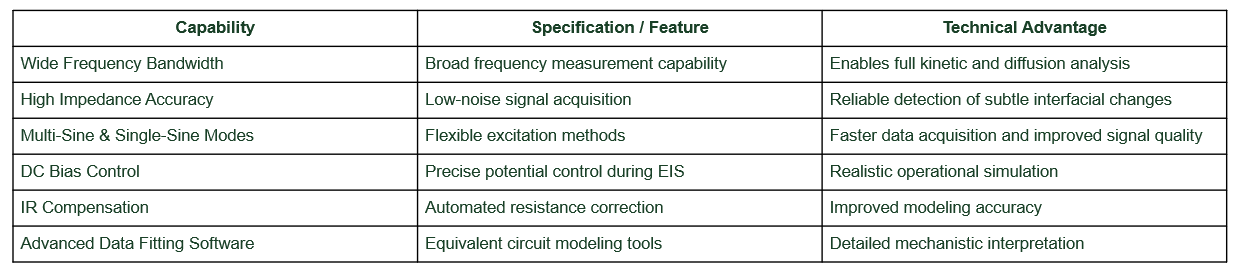
EIS Capabilities with Admiral Instruments Squidstat Plus
Squidstat Plus offers a full-scale current range of 1000 mA to 100 nA and an EIS Frequency Range of 10 μHz to 2 MHz.
Optimize your batteries, supercapacitors, catalysts, and coatings with high precision EIS testing. Submit your samples today and receive a detailed impedance analysis to enhance efficiency, durability, and reliability.