From Sample to Solution – Simple & Fast
Surface Energy Analyzer
Why are surface energy and contact angle testing important?
Water droplets bead up on a surface instead of spreading, leading to poor cleaning or coating performance.

Liquid does not wet surgical implants properly.
Microfluidic devices show poor fluid flow due to improper surface wettability.
A PVD coating cracks because of poor adhesion between the substrate and coating material which can be enhanced by proper surface treatment of the substrate.
If you face similar problems than surface energy analyzer can give you the solution for it.
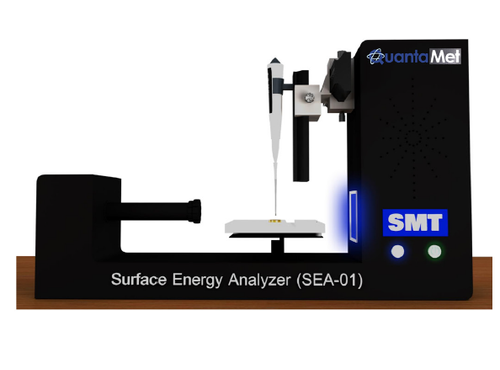
Surface Energy Analyzer (SEA-01) uses advanced contact angle measurement techniques to precisely determine the surface energy and wettability characteristics of your samples. This method provides quantitative, reproducible, and objective data, enabling reliable evaluation of surface quality.
Contact Angle in Relation to Wettability and Surface Energy
High Contact Angle (> 90°): Indicates low wettability. The liquid "beads up" into droplets, characteristic of hydrophobic (water-repelling) surfaces.
Contact Angle and Wettability,
Low Contact Angle (< 90°): Indicates high wettability. The liquid spreads across the surface, often seen on hydrophilic (water-loving) surfaces.
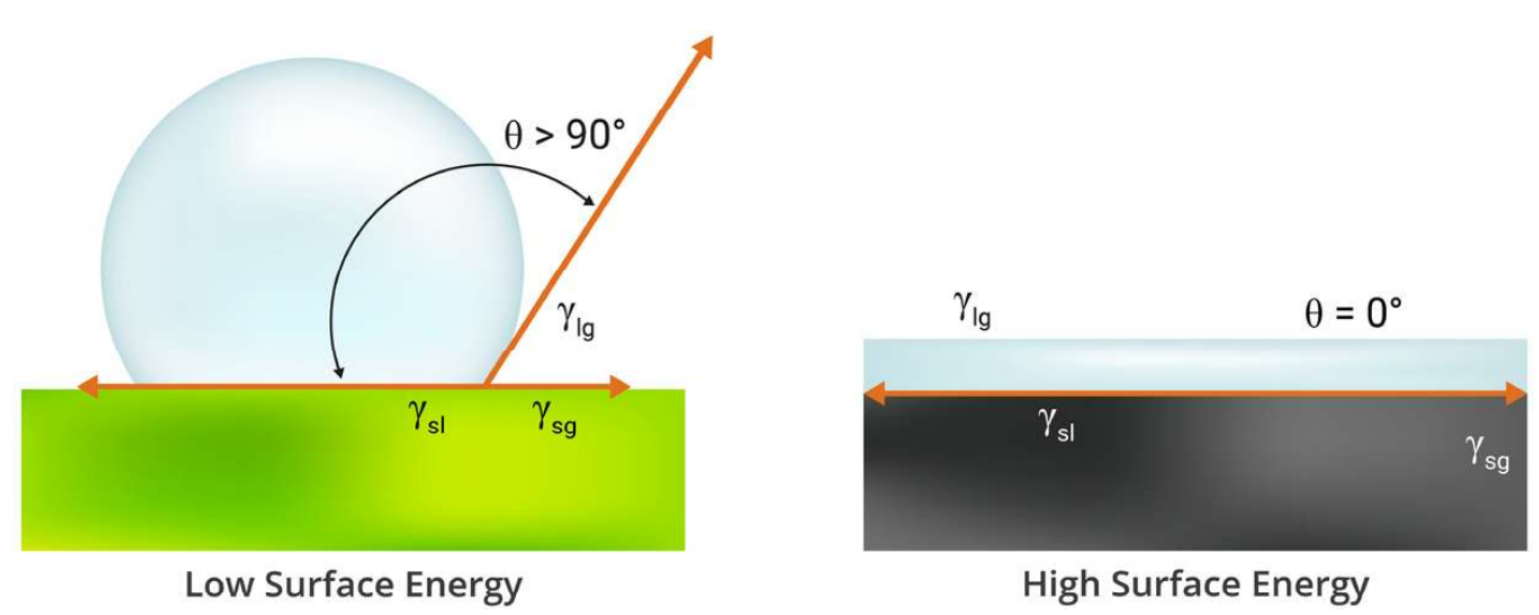
Surface Energy and Its Effect on Contact Angle,
Higher Surface Energy: The surface has a strong "pull" or attractive force, overpowering the liquid's internal cohesion and forcing it to spread out. Higher surface energy typically leads to a lower contact angle.
Low Surface Energy: The surface lacks the energy to attract the liquid molecules strongly, allowing the liquid to maintain its droplet shape. Lower surface energy leads to a higher contact angle.

Surface treatments like plasma or chemical coatings can be used to increase surface energy for better adhesion. Better adhesion when surface energy is high.